
Notes on Daegu
"I didn't hear a splash."
NB: This is a work of fiction. The narrator’s attitudes and language do not represent the author’s own views.
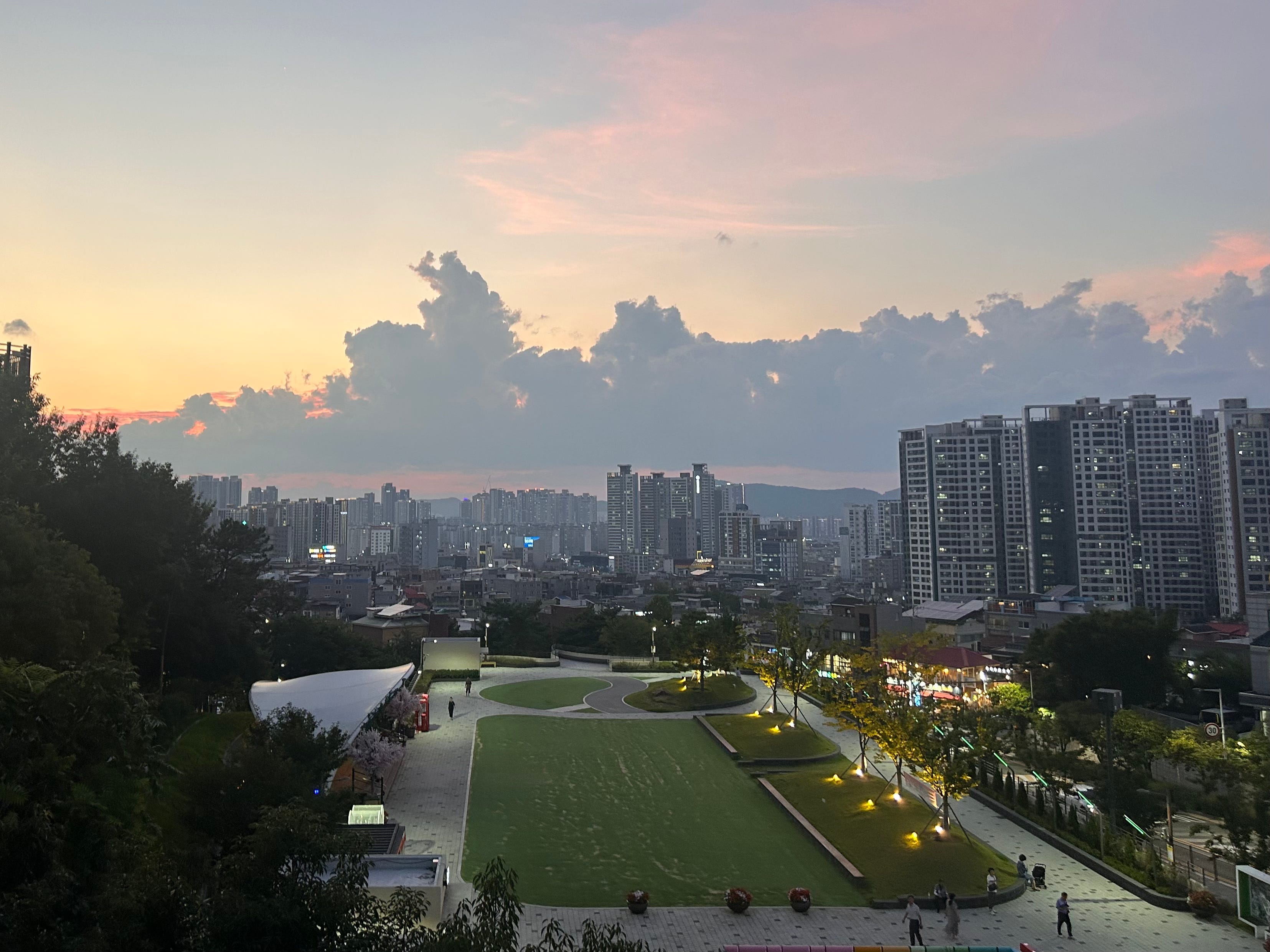
Upon check-in at the Noble Stay Hotel in Daegu, I was surprised to learn I had been assigned the accommodation’s legally mandated handicapped suite. In truth, I had never considered the existence of such suites, but it dawned on me later that day, using the padded toilet, that however good a regular suite might be, the handicapped version would always be better. This was why very late on my first night at the Noble Stay Hotel, while watching a variety show featuring many beautiful women, and even several beautiful men, it occurred to me that FDR must have had the presidential suite to top them all.
Though my suite was not suited to a handicapped American president, I thought that it might have befitted the handicapped dictator of a minor island chain. The shower was big enough to host an accessibility-enabled orgy; the toilet had various handles to prevent you from falling to your death. But the tradeoff for all of the legally mandated extra space, I realized the next morning, was that there was no natural light—the alley almost touched the room’s lone window, making you feel as if you inhabited a rodent’s den, and indeed that you might slowly be turning into a rodent.
What I concluded on the second day, over a breakfast that was not included, was that there must not be many handicapped people visiting Daegu these days.
Later that second day, I was propositioned by a Korean woman to go on an adventure. Because I desperately needed to write something for my book about Korea, about why the people weren’t reproducing much, I said yes.
B picked me up from my hotel at 4:00 to beat the traffic, to really wallop it, considering most Koreans don’t get off until many hours later. And yet, here on Daegu’s central artery, it is a coronary event. The city government, of course, deludes itself—it says one more subway line will fix it. But in Daegu, everyone just wants to run over pedestrians in their big Hyundais.
Thankfully, B got her blood-red Subaru Outback used, so she doesn’t have to worry about the dents and scratches associated with such sport. If it were new, she explains, it would be an object of fetish, and she would have to take the subway.
And this—the new-but-not-too-new Subaru—is why she is driving everywhere, despite inhabiting a nation where the trains never run late. She’s thirty, but she just got a license, and so she’s more like an American teenager, though she insists, when I suggest this, that she is so Korean.
We are driving into the Palgongsan Mountains, one of several ranges encircling Daegu. There are brown splotches of dead leaves among the piney green slopes. It was a bug that did it, some invasive species (the pine wilt nematode via the Japanese pine sawyer, in fact), though she can’t quite find the term. That’s what her mother told her.
Through the windshield, on this otherwise rainless day, I watch a full air force of flying insects rain down, their whitish guts and skinny legs smearing across the glass.
“I don’t know why they like to kill themselves,” B muses.
In almost any other country, driving into the mountains with a stranger, even a very small woman, would raise suspicions in my mind that I’m being driven to a shallow grave, a kind of vivisection for sport. But in Korea, despite the many native movies in which this exact scenario unfolds, the thought doesn’t possess my mind, but lingers there, a bemusing spectacle.
But what of the spectacle of the Subaru? Let’s do an accounting. There is a little air freshener cube stuck to the AC vents; one of those pastel-colored Nordic backpacks in the backseat—you know the one; a 40 oz, possibly 48 oz, thermos in the cupholder, which looks like total excess, and makes me suspect she is keeping a pet hamster in the glove compartment.
So, you see, she is just like you or me.
“But why would you come to Daegu?” she asks.
“It’s the third biggest metro.”
“But there’s nothing to do here… And it’s too hot. You know we call it Daefrica.”
It comes to me, very suddenly, that a counselor at a summer camp once referred to Memphis, my hometown, as Memphrica.
“But it’s a real Korean city,” I plead.
“It’s probably the most boring Korean city.”
“Why?”
“Well, I don’t know… I think it’s too flat.”
I think, looking at the dashboard LED display that reads SZA, I know what she means. A hilled city creates suspense in its troughs and awe at its peaks. But a flat city—it is good for little beyond driving in the rain and infantry assaults.
What redeems Daegu is that it has hills around it. And it is approaching the foot of these hills that, to my great delight, a sign for the birthplace of President Roh Tae-woo appears overhead.
“He was president in the ’90s, right?” I ask.
“Yeah, but you probably know more about history than me.”
“What is the history of Daegu?”
“Daegu doesn’t have history. If you like history, you should visit Gyeongju.”
B had just gotten off her job, which she did not enjoy so much as tolerate better than the alternatives. The job, as she explained to me, was just about the easiest a Korean person could ask for: part-time English kindergarten teacher. So, for several hours a day, several days a week, she sat cross-legged on a grimy carpet, surely fashioned with a cartoonish map of a city, and played games with adorable children, the spawn of parents who would go to Abrahamic lengths to see their children get a good TOEFL score.
Her true ambitions, however, lay elsewhere. As she explained, “I’m a beach girl.”
It was not hard to believe, because B, relative to many Koreans, and indeed my own vampyric complexion, was quite tan. She was also dressed in a pink spaghetti-strapped top that really popped, whereas most Koreans prefer something that recedes. Then there was that heart-shaped tattoo, visible on her sun-stroked shoulder as she turned the Subaru onto a steep, two-lane road. But it looked as though the tattoo, along with the impulse that produced it, had faded.
Studying her tattoo, I asked what she would do if she didn’t have to work.
“I wouldn’t do anything,” she said, with no particular shame.
It filled me with a little dread; the urban music she had chosen for this ride pulsed.
“But you would have to do something, right?”
“Maybe just stay at the beach.”
Her old job, though—this I found very interesting. She worked in Malaysia for five years after college. Kuala Lumpur. Communications for some booking agency, something like that—telling Korean clients that under no circumstances could they get a refund, as per the fine print. And it was a great time, because she could afford an apartment downtown, right next to the subway. Far beyond having a beach nearby, she had her own pool.
But she quit. Because, though she preferred the beaches of Malaysia to those of Busan, she preferred the part-time work hours at the Daegu kindergarten even more. And so, to reconcile the two—the desire not to do nothing with the desire for tropical adventure—she developed a habit of picking up foreigners in this third-tier Korean city.
The place B chose for my vivisection—I had no say in this—was a little coffee shop up the hill, which B’s Subaru was laboring against in what I began to worry was Sisyphean fashion. Still, the ginkgo (eunhaeng) trees looked truly lovely that time of year, that proto-autumn period some refer to as late summer. The maple leaves broad and healthy; the ravine’s trickle through granite and gullies... I enjoyed being there because, as far as I could tell, there were no foreigners nearby. They would never get to see the real Korea as I did!
B backed the Subaru into the gravel lot, not unlike someone in Memphis. Opening the door, I felt the rubber sole of my New Balance sneakers contorting against the stones—an unusual sensation in that paved paradise. It was the heat of the day, but the maples spilled shade over the lot such that it only occurs to me now that it must have been hellishly hot. She led me, tugging gently at my leash, to the mountainside coffee shop, the exterior of which read:
BERGEN
WE PROVIDE FRAGRANT COFFEE
A BAKERY FAITHFUL TO BASICS
Inside loomed a freestanding pastry display case, filled with heaping masses of fluffy, chocolate-paved carb; ceiling lights smudged the surrounding grey, concrete floor like icing. But there was almost no one there, save the two handsome, black-aproned baristas stationed at a surgically complex counter. Who would come all the way out here on a weekday to get coffee?
I bought B $10 worth of latte and croissant, feeling some unease at the improbable sum. Of course, she was driving me around, paying for gas, oil changes, and insurance, so I was still coming out way ahead, indeed so much so that I was secretly reveling in my highway robbery.
The coffee shop, true to its name, was something of a city unto its own, consisting of separate buildings for ordering and seating. In the building dedicated to seating, the upstairs was half wood, half concrete, surrounded by green maples a month or so from their autumnal splendor. Mid-century modern chairs around the central tables, with a few IKEA stools lined along a bar facing the forest window. All that was missing was the fjord—the barista said they were going to install the fjord next year.
I collected the drinks and croissant on a metal tray, balancing them as I traversed the vast complex. Someone had thought to post a map of the coffee shop’s two buildings near the entrance in case I got lost. When I finally arrived upstairs with the tray intact, I understood why B had chosen the place.
“I have 36,000 pictures on my phone,” she said, as she flitted about the empty coffee shop, pointing her phone camera at the greened-over windows, in a place where windows usually revealed concrete beanstalks.
The number seemed very large, and what occurred to me, inserting a paper straw in my iced americano, was that there would soon be adults whose entire lives were contained on their phones’ photo apps… You could watch their lives, from early childhood to adulthood, unfurl. You could swipe your finger on the screen and watch them transform from stunted juveniles taking gauche selfies to full-bodied specimens posing in the chicest coffee shops. Photo albums had always been a thing, but always quite staged, mediated by overbearing kin; this kind of photo album was much more honest, given the individual effort underlying it. Again, it filled me with a little disquiet.
As a kind of confession, I have no idea what I’m doing. I’m trying to write a book about Korea, and my assumption is that if I meet as many Koreans as possible, they might show me where the uranium gets enriched, etc. My problem is that, save for uranium enrichment, I don’t know how to gauge what’s interesting. Abstractly, we all know there are people from different cultures with strained family relations and so on; so, is it interesting if a single person tells you they have strained family relations? If a proof of concept is the goal, why not just write a novel?
The broader problem is that I’m inhibited. I suppose you have to fail repeatedly until you lose inhibition. Henry Miller, for example. But as a kind of defense, I’m inhibited because I don’t see the possibility of a path, even à la Henry Miller… Because, as you and I both know, the literati, the court mandarins, the eunuchs over in Brooklyn—they would object. They would say, “penis with a thesaurus.” And whose approval would that leave me with? I couldn’t get B to read this if I paid her…
But B, who has just finished the coffee tray’s photo shoot, must have great stories to tell—she sailed out on a rickety clipper for British Malaya years ago. She saw the tribesmen sucking sap from rubber trees; the Chinese and Indian middlemen hawking tins of opium and cardamom; the indigenous peoples milling about in all their indigenous wisdom…. She might just have a Conrad novel brewing in her! And with enough tact, I might be able to coax it out of her for myself!
But it may take time, because she is now looking at her phone.
“Sorry, it’s my job,” she said, taking a bite of a croissant that could have fed an entire Sakai village. “They never stop texting you.”
“What are your hours?”
“One to three.”
I had never heard of a one-to-three. It sounded very nice.
“If I wanted money, I would go back to Malaysia,” she continued. “But right now I’m just chilling. I want to enjoy my life.”
At this, I winced violently. Chilling. Sloth! Enjoy my life. Hedonism! Where did she get the right?
Getting back to my Conrad beat, I asked B if she had any tales of tropical adventure, misplaced bags of gold bullion, haunting moments of indecision in the face of calamity at sea…
“I have one great story,” she began, stirring the cloudy beverage in its sweaty tin—they put it in a tin!
I leaned forward, my khaki’d ass giving the tawny leather upholstery a good creak.
“When I was in Malaysia, one of my Korean coworkers lived in the same building as me. And one night he was drinking after work at the office…”
From where I sat, her face had now transmogrified into that of a seasoned raconteur; her voice graveled over with a Tom Waits inflection; her dainty hands, normally tipped with red nails, now gnarled and calloused.
“But he got, like, soooooo drunk… You know how Korean people drink, right? So the CCTV cameras showed him leaving around 9 p.m. I guess he was going to walk home, but then, after an hour, on the camera, he came back. He was still drinking! And then he went and got on the boss’s desk...”
“He took a shit?” I interrupted, feeling I had heard this one before.
“No, just wait—he finished the beer, and threw the can down,” she continued, spiking an invisible football. “The cleaning ladies were there, but they still didn’t see him… On the camera, he disappeared again for a few minutes—no one knows where he went! But then he came back again, and went straight past the boss’s desk to the corner, by a potted plant…”
Could it really be?
“...and then he pulled his pants down, and took a shit.”
“A shit?” I asked, still finding it too familiar.
“A shit,” she insisted. “He left before they found the shit. No one knows where he went... But the next day, someone found him by the apartment pool with his pants down. And since it’s a Muslim country, this was very haram. Apparently, the cleaning lady who found the shit was screaming.”
“What happened to him?”
“He was fired. But I know his girlfriend—she found out about what happened, and she’s still with him.”
The socially mediated capacity for self-destruction was, I noted, a distinctly East Asian phenomenon. Westerners drank themselves to death alone, but Easterners saved it for an office party. And what was the man who drank until he shat in a potted plant, but an heir to the man who flew his plane straight into a U.S. warship?
A couple had now come in, two slackers beelining from the office, and commenced a photo shoot for their frothing lattes. I looked at B’s croissant before me, reduced to a nub, a bone-picked, rotting carcass…
“And what about you?” she asked.
“What do you mean?”
“Do you have any stories from Korea?”
“Well, my students were older—they knew how to use the bathroom.”
“But outside of teaching?”
“I guess I saw the president get removed…”
She sipped from her tin with a straw.
“It’s okay—Korea is not a very exciting place.”
Behind us, the couple was still taking pictures.
It was now 5 o’clock, and all the Korean bureaucrats—only the Korean bureaucrats, with their iron rice bowls of $22,000 a year—were starting to get off work; the not-quite-busy worker bees buzzing about while B and I went back and forth over old conquests, great games, imperial ambitions—yes! We both agreed Siam was looking a bit wayward, that Hong Kong had seen better days. Burma? B could have that one—good luck! But she had had enough of this chatter; as I folded up my sharpied map, she noted that she would like to visit the Donghwasa Buddhist temple up the mountain. The curtain of Palgongsan’s slope had drawn over the afternoon sun, and B wanted to get there before dark. She hates to drive in the dark.
In the parking lot outside, the low light was striking the beige stucco of the coffee shop’s turret. Ahead of us, you could trace the road we had come on until it vanished down the hill, as if sucked into the basin’s opposing mountain range.
I tried to open the door to the Subaru to no avail, before B pressed the button. As I folded my legs into the passenger’s nest, the sun was beaming through the windshield in my face. I put on my seatbelt, and B started the ignition, exiting the gravel lot to the tune of Frank Ocean.
Much like B, my mom always liked R&B. Not SZA or Frank Ocean, of course, but Motown, and not least Marvin Gaye. On the way to my very expensive private school, listening to his early hits, she would always tell me about Marvin Gaye’s tragic death, which resonated all the more because my father, a developer, had hired a schizophrenic black man named Marvin as a carpenter. My father liked Marvin because he showed excellent craftsmanship and was not an alcoholic, neither of which was a given in Memphis. I remembered, watching B, that Marvin used to throw the football with me whenever he came to see my father, which my father had never done, not having any interest in sports that did not involve guns or heavy machinery. But one day Marvin threatened to kill my father for using satellites to listen to his thoughts, and that was the end of the relationship.
What I found amusing, staring at the LED paneling of B’s Subaru, was that when my mother wasn’t listening to Marvin Gaye, she was listening to Rush Limbaugh.
We were now crossing a narrow bridge over a gully, hunting for the expressway on this little country road, when a rival Kia lurched toward us. For a moment, I thought B had gone down a one-way and we were headed for a head-on collision, which, after momentary worry, I realized would make simply fantastic writing material. But as we hit the coiling summer blacktop, a greater worry emerged in probing B’s domestic background: Koreans spent most of their childhoods in academies and classrooms, leaving them short on tales of misadventure. And the more I asked, the more I realized I was asking a man who had spent ten years in solitary confinement to spin a tale…
“I just had a typical Korean high school experience,” she said. “You go to school until 11; you don’t have much of a life outside of that.”
“But was it worth it?” I asked, watching a man hawk watermelons out of the back of an ancient Kia truck bed. He had cut one to display the red innards.
“When I think about it now, I wish that I had just learned basic skills. Koreans are obsessed with becoming lawyers and doctors, but I wish I had just learned how to do something basic.”
“Like what?”
“Maybe accounting…”
But where could you find a one-to-three accounting job! Really!
“I guess there’s not much dating, going to school that late,” I said.
“People flirt when they study.”
She was now drinking from the mammoth thermos. I desperately needed to know what was in it.
“I’ve always wondered,” she said, putting the thermos down. “Do you really have a prom?”
At this, I felt a pang of embarrassment, indeed so much so that I looked away from B after I told her yes, just like in the movies, because the truth was that I did not even attempt to go. Largely because I was shy, of course, but since I went to an all-boys school, this made it all the more hopeless. Attending what we called the prom required immense coordination, logistics, the favor of providence, crossing red seas, and I simply did not even know of anyone with whom I might go—I simply did not know many people. Though perhaps as a kind of coping mechanism, I do not think now it would have gone anywhere, because Memphis, as you can imagine, is just hopeless for someone like me in matters like this.
So how did I end up here with B? I am really quite a weird person, and not in the fashionable way. Still, I have redeeming features: namely, I am tall and white! Of course, it is a wretched thing that I am being exoticized, objectified, and not appreciated for all my vaguely autistic qualities. But I am something of a Benthamite about these things…
We had scarcely traveled five minutes from the Nordic outpost when B’s phone detonated. She was receiving a call, and the ringtone sounded like the music they play on a bus in Central America.
“Yeoboseyo?”
“Hey, baby girl, what’s that Mexican restaurant in Daegu we went to?” a woman asked. The voice was raspy and American-accented.
“We’ve never been to a Mexican restaurant in Daegu.”
“No, no, we went to a Mexican restaurant, jinandalae…”
“I swear, we’ve never been to a Mexican restaurant.”
“We were there with Sunny, baby.”
“I don’t remember it…”
“Jinja…”
The stranger was now wheezing, coughing, spitting bile.
“You still sound sick.”
“No, baby, I’m fine. I rested all day.”
She, in fact, sounded terribly ill.
“But I don’t know any Mexican restaurants…”
“Geureonde...”
“Are you coming in tomorrow?”
“I was planning to…”
“But you’re sick, baby…”
“I’m fine, baby…”
“I saw you today, baby…”
“I will have to get a note…” the stranger said.
The conversation ended there; I was mesmerized by this moribund woman speaking a Korean-English creole.
“She’s American?” I asked, while transcribing the creole in my notes app.
“Filipina—she’s the one who helped me get the job at the kindergarten.”
A silence suddenly descended upon the Subaru, one that I would have once found awkward years ago, but which I had gradually learned to embrace. Indeed, I have found strategic reticence a means of cultivating an air of mystique, poise, etc., even where there is only consummate panic.
For the ensuing ten minutes, I accordingly looked out the window, trying to think of how to describe a landscape. I had been reading V. S. Naipaul’s Enigma of Arrival, a dreadful book, and he just goes on for ages about the soil and sticks and stones… And what is the point of it, in the screen age? It is terribly boring but equally impressive, like being on ketamine…. And what I remembered, gazing blindly out the window, was high school English with Mr. Gropeman… (He was, in fact, almost certainly gay.) One day, he had tried to make the class write like Annie Dillard anonymously as an exercise, after which he would read the Dillard approximations before the class so we could vote on which was best. But when Mr. Gropeman presented us with this, I could not even imagine myself writing like Annie Dillard—it is like those people who have no sense of rhythm or no mental image… I cannot describe a landscape... And so, when Mr. Gropeman finally read my passage before the class, he winced his face, which was attached to a very bald head. And I remember that, far worse than rejecting it outright, he was simply confused, because, you see, I had written about the interiority of a person.
The crunching leaves! The babbling brooks! A twig snapped! Natty Bumppo ran… But I needed so desperately to describe a landscape; it is one thing to see a picture of a landscape and quite another to know how to describe a landscape. Description is an act of invention; before we describe, we do not know what we see... We are indeed blind like the mole, having vague notions of color, of light, even of objects, but lacking all precision. I can remember, for instance, that there were farms out the window, but what was the nature of the crops? Did they have vines, bear fruit? I did not see this; I only glanced at the sum of these many parts, and never probed the components, and so I am left with the vaguest impressions, which do not serve this medium...
At 5:37, dashboard time, I was overcome with the sense that if there was no possibility of having sex with B, I would need to get back to my handicapped suite as soon as possible, and read The Growth of the Soil.
It was going pretty well with B, I thought, out on this thing with no particular definition. Was it a date? Well it’s hard to say, in this second space age... I have to check out of my hotel in three days. That can be a problem, sometimes. But we have rapport. She is an easy person to talk to. And a woman who picks you up from your hotel—what is that, but 21st century romance?
The book, however, seemed quite hopeless. That was always the paradox of these things.
Out the window of the Subaru, fields of leafy green rippled toward the road. We’ll say it was perilla—yes, now that I think about it, it was definitely perilla, with its oval, serrated leaves bobbing in the green, ripply wake. Below the undulating peaks of stone, early evening sun filtered through the maple woods… To the right, a sign informed us that the giant stone Buddha of reunification was just around the bend, as if he ever cared about some petty squabble like that.
I asked B if she had any relationship with Buddhism.
“No, but my mom is Buddhist... She would always take me to the temple for holidays. But I only liked to go for the bibimbap. They have the best bibimbap because they use fresh vegetables.”
Her mom was a member of the Jogye Order, she said. But what did this mean, really? B did not know.
My students never showed much interest in Buddhism, either. During the week of Buddha’s Birthday, I would march around the classroom yelling the word Buddha at each individual student during the week of Buddha’s Birthday until a precocious student explained that the Korean term was buchyo. But this didn’t help! Buchyo! Buchyo! Anyone? They weren’t Buddhists; they weren’t really anything. They just wanted to sing and dance… It made me suspect that Buddhism, to the extent that we can pretend such a thing exists, would not survive modernity, save in its accessorized variations.
Up another hill, twenty minutes from the bakery faithful to basics, stood the Donghwasa tunnel, before which rose a traditional gate with black upturned eaves, a teal dancheong pattern, four red columns, and a black sign with gold hanja:
八公山林桐華寺
Beside the gate sat a security guard’s box, with not a soul, bodhisattva, or even a misplaced arhat at home. The checkered bar looked immovable.
And it soon became clear why: the dashboard read 5:46, and the temple had closed for the day. In truth, I was very disappointed, because the tunnel behind this gate looked like it would lead to a great secret; indeed, the uranium enrichment site that some old dictator had once pretended to close. Of course, it was tourist fare anyway. Really, I’m not sure why I was this disappointed—a bit angry, even. I suppose it was because I’d never get back up here to this gate, since I’m too cheap to pay for a taxi. My one chance to cross, and B didn’t check the hours!
Perhaps B could sense my displeasure from the audible sigh I emitted amidst these thoughts, but looking over, I found her nestled in the driver’s seat, fumbling with her phone to reroute. She was really taking good care of me, I have to admit. Unfortunately, I couldn’t help because I had no data on my phone. I have a bad habit of not buying eSIMs abroad because they’re tedious to purchase, trying to install, and prone to malfunction; furthermore, I refuse to pay the $12 a day my domestic carrier charges. This makes me completely dependent on public wifi, which the Korean government, despite its much-vaunted tech-savvy, still has not extended into Palgongsan. So it appeared B would just have to shuffle through KakaoMap for us. And boy, was she really laboring over there, her nails clacking gently against the iPhone screen (it was always an iPhone, never a Galaxy). But it would have been quite pathetic if I hadn’t at least tried, so I began thumbing through KakaoMap myself, pretending there wasn’t a text box on the screen that said no connection. It was a convincing performance.
After a couple of minutes of pretending to help, B finally announced that instead of passing through the tunnel, we could go to a scenic bridge on Apsan, the opposing mountain of Daegu’s basin. Would we visit the port next? But I had no say in this. And then, to my great consternation, she added,
“It will take forty minutes to get there.”
The great tragedy of it all, I thought as we began our descent of Palgongsan-ro, as SZA’s algorithmic kin bumped and thumped past the ginkgos, not unlike the fetid ginkgos I used to walk through in Overton Park, was that I could spend another forty hours in this car with B and would never know much about her. But I had come so far! The only thing separating us was the cupholder struggling to contain an oversized thermos. And yet she had already shared her one great tale—the shit in the potted plant! But besides tales of scatological intrigue, people never knew what was interesting about themselves; indeed, they never knew what they knew.
But what if it was really quite simple? She had gone to school until 11; I had known that three months ago in Memphis. It was an illusion, a desperation to say that things were so worthy of relentless inquiry in this fashion, of talking to real people. Really, if one were interested in truth, I thought as B cleared her throat (she probably had a cold from the kindergarten, and I would probably catch it), you would only interpret foreign cultures through data. You would strap on a VR headset and watch ten hours of visual footage of the streets of Daegu before ingesting vast data sets about its people. But you would never talk to real people, because given the limited nature of your sample, its selection effects, this could only distort a truer understanding of the place. And these people who go around talking to real people—the same real people, mind you, who can’t point to Iran on a map in one of those late-night street interview bits—it is no different that people who take acid in search of insight. There is no insight; only temporary stupefaction.
“Are you too hot?” the Korean woman next to me suddenly asked.
“Oh no, I am fine…”
But to be sure, I thought, as B cleared her throat again, confirming that she had a cold and that I would catch it (she had caught it from the Filipina, of course), you could learn nothing from a book either. Books, by their very anachronistic formatting, are a form of artifice, designed to flatter the writer and reader, to launder prestige to both by fashioning something material out of mental onanism. If books were true, of course, we would have stopped writing them by now. There would be a single book on Korea that was continuously refined and edited, and indeed, all the old ones would be burned. But this doesn’t happen because then the many would-be writers could not indulge in the delusion that they have something so transcendentally important to say that it is worthy of a new book. And how, then, would writers go about acquiring status, indeed having sex?
Of course, I am no monk. I am no Buddhist—Jogye, Taego, or otherwise. I would like to get along in the world, acquire my status, have fun dalliances... But they will not let me! They hoard it for themselves in their little brownstones, hiding behind vaunted names while they cow real people into reading their drivel. Of course, they make feints—they say it is about human rights, accountability, yes, an electorate well informed of the latest plane crashes and celebrity sex scandals… They delude themselves into believing it! (That is not to say I wouldn’t, too, if they just let me in, I thought, as the seatbelt jammed and I found myself pinned to the seat in utter despair.) Because without this masterful, institutional cowing of real people’s feeble brains, and indeed this masterful cowing of my own brain, I have no hope of tricking a reader into thinking that real people matter—and even if you could be tricked into thinking that real people matter, why would you care about B? In her own words, she had an ordinary high school experience; she is the average, the median, the mean, a form, less than a person, to you, anyway. To me—well, those bare shoulders!
But what of her family?
“It’s hard to explain. My mom—when I was a kid, she divorced my dad and remarried. And then I lived with my stepdad. And I never really liked him…” she said, thinking about the reasons why she did not like him…
“But by the time I was in high school, my mom divorced again, and this time she got back with my real dad.”
“That’s kind of romantic,” I said.
“It was actually very traumatic.”
I wondered where she had learned that word.
And the siblings?
“I have an older sister—only a year older. She actually lives close to me.”
“You get to see her often?”
“No, we don’t get along.”
“Why not?”
“She’s immature… She never shows up for any family event. We had my grandfather’s birthday recently, and she refused to come.”
She was thinking; she was gripping the Subaru’s wheel with two tiny hands, and she was thinking.
“It’s because of my brother-in-law… He brainwashed her.”
“But how?”
“I mean, we all went to her wedding—she had a big wedding! You know, Korean weddings aren’t like that; they’re like factory lines. You get in and get out. But she had like a long wedding…”
She was letting her left elbow rest against the door and leaning her head on her hand.
“Ever since the wedding, they’ve been so independent. We all came to the wedding and gave them money, and they just disappeared after that.”
“But she lives close to you.”
“She lives around the corner from me.”
“What does she do?”
“She’s a nurse.”
“Does she have kids?”
“She had one after getting married.”
She was gripping the wheel with her tiny hands and pressing the brake with her small foot.
“And I crocheted something for my niece’s birthday! But they never said thank you…”
The road was almost perfectly empty; a void, a vacuum of black tar and yellow em-dashes. But suddenly, another car appeared, swerving, straining, using all the torque one can muster from a Korean car. It raced past us, the frame tilting as it rounded the wooded bend ahead. We had a good laugh until B said this was where the teenagers in Daegu learned to drive.
“Does your sister make you not want to get married?” I asked.
“I mean, marriage is something I think about… I can see myself getting married one day. But there’s still so much I have to do…”
“Like what?”
“I haven’t even been to Europe!”
“Maybe you could visit on a honeymoon.”
“But I prefer to travel alone… I like to make my own itinerary. And honestly, everyone already wants to travel with me. I need more me-time.”
“Are your friends getting married?”
“One of my friends actually married an American last year—a military guy. She moved to the US after the wedding. I always see her Instagram stories now.”
“Where in the US?”
“Mississippi. I forgot the city.”
“I have lots of family from there.”
“But to be honest, I didn’t think the city looked very nice in her stories…”
We were pulling to a stoplight. You could see the rally car parked at the light. The bumper said unjeon yeonseub.
“And what about you? Do you want to get married?” she asked.
“Maybe one day. But I still have to finish the book.”
The truth was that marriage with B sounded unpleasant. And yet—hear me out—she loved her me-time. This meant, possibly, that marriage with B would have had the virtue of not being so demanding. Certainly, it would generate fantastic writing material—the sheer anthropology of it all! Of course, her parents’ relationship sounded like a disaster, and that is never a good omen, what with genetics and all. Though, again—the anthropology!
It was amidst these careful thoughts that our sortie proceeded along the Sincheon stream, constructed in the 18th century at the order of a local bureaucrat—it always worked like that, of course—to contain the floods from the Geumho. Daegu, beyond being very hot, is prone to floods. But these are not floods of a Biblical proportion; the stately stream is so sedate that you can walk across a bridge of stones to the other side, or at least you should be able to, I thought to myself while watching some magpies flitter about the reeds. It was really the overpasses, the several thousand tons of asphalt, steel, and concrete that imposed.
Past the sedate levees that never break, to the tune of rhythm and blues, B returned to the matter of Malaysia, presenting her ethnography of this tropical oasis. It was a curious ethnography because, as far as I could tell, Malaysian people did not feature in it as much as Chinese and Indians.
“The Chinese, they are rude, they are loud, they think they are the center of everything. And the Indians—they stare at you. And the smell—oh, God! I can still smell it!”
As a strictly objective matter, I noted that some Korean people seem to dislike the Chinese.
“We call Chinese people cockroaches,” she boasted, laughing. “We can say that.”
I had heard variants of that one before… But what it reminded me of, which B could not possibly have gleaned, was that my entire home life was a series of infestations—not least the cockroaches in my home on Melrose, my shadowiest memories being the silhouettes of prehistoric bugs tracking the cereal box in the cabinet…
Oddly enough, there was really a kind of Biblical progression to it all, I thought, while a Presbyterian church with a neon cross came into view, its tubes betraying no glow save the faint glow of the dying sun, because when I visited my parents after time away, indeed 20 years or so of inhabiting this home my father never quite finished, I discovered that far beyond roaches, there were now rats scurrying about the kitchen. And my father, when I suggested that he hire an exterminator, he said in earnest, “I’ve already shot 5 of them in the past two months!” And I said, with a kind of self-righteous concern that was not completely earnest, “It’s been over two months; by now there’s a nest!” And at last, with a kind of faux paternal wisdom, amidst a refrigerator that had leaked through the floor, amidst the vacant rat traps and ants marching like they had been reading up on squatter’s rights, he said, “At Annesdale, we always had rats and roaches.” The man would contract plague for his memory of Annesdale!
This was all to say, at the risk of sounding like a moralist, I quite liked the behaviors B ascribed to Chinese people.
We were now at a stoplight, and B was hunting for a scented lotion in her Nordic backpack, fumbling, wrestling with the pastel blue contraption. But the light was about to turn green any second! And there it went! And now she was accelerating while she fumbled for the lotion!
My mom, I remembered watching B with contempt, was a terrible driver... Violent, herking-and-jerking motions wherever we went. (The Marvin Gaye could not have helped.) And what I noticed, one day, was that my sister drove just like this… Like a speedhead. And so, like everything else, it is genetic. But B’s polygenic driving score isn’t that bad—she drives with a certain gravitas, a certain southern apathy. She drives Miss Daisy damn well, I do say! Of course, it’s not like she has somewhere to be…
“Are you close with your parents?” I asked. A line of bikers was racing along the stream. They had the headgear and everything.
“To be honest, it’s part of why I moved home… I wanted to see them more. My mom hated me being so far away.”
“What kind of people are they? People say Daegu is conservative…”
“They can be pretty conservative about some things.”
“Like what?”
“Well, my mom always used to tell me—don’t marry someone from Jeolla.”
We had marched halfway through the basin, such that Apsan Mountain, the southern hem of Daegu, was now looming. Its peaks, shorter than the Palgongsan, floated in the dusk, a dull grey, scarcely green, amidst this light haze, the little particulate film that covers Korean cities by nightfall. To our left, the CUs, GS25s, 7-11s, dot the curb, teens lounging in little rest areas that you could never have in Memphis, looking at phones, sipping cold drinks. And now, between it all, concealed in a Japanese frame wrought with Japanese steel, it is B, 30 years old, a native of Daegu, and the American, 27 years old, a native of Memphis. Both are fit, keen to travel, and unlikely ever to reproduce.
The question I had for B, now fiddling with the AC vents, perhaps because she could tell I had broken into a feverish sweat, was how she became such a worldly person, penning these amateur ethnographies of the Chinese and Indian diaspora.
“Do you know the game Mabinogi?”
I could not even begin to conceptualize the game Mabinogi.
“Well, my friend and I in high school became very addicted. We would go to a PC bang during break and stay from the morning until late at night when they kicked us out. And this was when people still smoked inside… Finally, we said, okay, we need something healthier, so that’s when I started traveling….. At first, I would just go to Busan, areas like that, and you know, at this time, I didn’t even have a smartphone, so I would plan everything out in advance… And finally in college, I started going abroad, first to Thailand—”
I stopped her right there, demanding that she hand over her tales of exploit in this simple, smiling kingdom.
“Well, the first time I went, I met this guy at the airport. We met because he shared a pen with me to fill out the customs card. And he was the manager of this big store and had a company car, so he gave me a ride to my hostel….”
The sky was fading fast… It was Monday somewhere in the United States… The tendrils of rosy-fingered dawn were tickling the East Coast…
“So he freaking dropped me off for free! It was the best car I had ever been in. It was a Benz-uh,” she said, pronouncing it the way Korean people do.
A Mercedes! In Thailand! 5,000 kilometers to ride in a Mercedes!
“You say it differently, though, right?” she went on.
But since the book was already quite hopeless, I thought I would get to the question, the nasty looming question, which it was my duty, having received money long ago for this purpose, and not wishing, like my father, to let the rats build their nest, to ask—of why Korean people were not having kids so much these days. Of course, I explained, it is not like I stay up at night thinking about the reproductive habits of far-flung peoples—that would be a bit odd—but I came across a headline—I did not even bother reading the story, really, finding it a bit dull— that said South Korea, and not least a city like Daegu, was set to shrink quite dramatically. And I would like to know if B has any thoughts on the matter.
“I don’t really worry about that, to be honest,” she said. “I just worry about myself.”
At this, the pit of my stomach churned like someone had opened a uranium mine near the pylorus. 11,000 kilometers! And that was all she had to say! She didn’t even drive a Mercedes! A used lesbian car!
“I have heard….” I added, summoning the composure of a dying man, “that it might create some problems… The pension system…”
“Well, I probably won’t be here.”
The bitch! The rank bitch!
Immediately, I looked at my phone in a state of disgust and despair. (There was nothing to look at, of course, since I refused to activate the data.) What could be said? No one cared that Korea would shrink. Korea, as an idea, was long dead. It was simply a place where people lived. It had habits and proclivities, but like all wealthy nations, it had no particular will to live beyond tomorrow.
Of course, I thought, staring at my disgusting reflection in the screen, one could not condemn the absence of this will, for the word for such will is fascism. Yet it was not as though B, like a contemporary German, fretted about the politics of such will—as you heard yourself, she sounded not unlike Goebbels on the subject of Chinese people. Rather, she had simply been corrupted: by English, by travel, by the burgeoning knowledge that one could live for only oneself and pay no social cost.
And in the absence of social cost, what can one do but go to the beach? What can one do, but give in to carnal desire?
The radio was bumping and thumping against a silky falsetto, an aural sludge made of Koreans and Africans… And what was B doing? B was now staring at Kakao Messenger while maneuvering the two-ton vehicle, as if to emphasize that she valued my life less than the dinner plans of some Filipina. At last, she looked up from her phone, taking fresh stock of two dozen other two-ton vehicles that could kill you instantly.
“I’m texting a guy in Ulsan—we are supposed to go rock-climbing tomorrow,” she said.
“He’s a foreigner?”
“He’s actually American… He’s in the military.”
I gnawed my lip. I was always gnawing my lip…
But perhaps we should address it head-on—what is B driving at, anyway, with all these rendezvous? We know it is not marriage or reproduction. But what of the associated act itself? Does that go with the package, or survive the civilizational holocaust as a hedonic vestige? Most academics, of course, are afraid to answer such questions, and so it falls to me!
Overhead, a green sign with white Arial font noted that the next exit led to Kyungpook National University, Daegu’s premier institution of higher learning. We were now pulling onto a ramp, leaving the sleepy river in its bed.
As a kind of reflex, I asked B if she had any memories from college.
“Not many… It was a long time ago now,” she said, with the tone of someone who did not revel in the past, but lived squarely in the present.
I looked at the black hair gracing her shoulders, wondering if she had ever dyed it blonde. And in the midst of my reverie, I suddenly realized she was trawling her brain, indexing the hippocampus—the cafeterias, the classrooms, the pickleball courts—while I watched in dread. 4th and goal! It all came down to this!
“But I remember one night I was walking back from my dorm,” she continued, releasing her small hand from the wheel and gesturing backward. “This was during finals season, when people just lock themselves in the library until it closes. Since it was so late, I was alone—I was always afraid of walking alone that late, so I was walking quickly. But when I got to the bridge, I thought that I heard something next to me… I looked at the gate on the side of the bridge, but couldn’t see anything because it was so dark. But I kept hearing something, like someone was moving… And as I came closer, I realized I was staring at a man through the gate...”
She was looking at the bumper of the jet black 2023 Hyundai Sonata ahead of us. The license plate’s digits were 7827.
“All of a sudden, we were looking at each other in the eyes.”
“He was—”
“He was about to jump.”
“So I called 119, but they just told me to keep moving, to not do anything. I felt like I should do something! He was right there... But they kept saying don’t do anything, so I after a couple of minutes, I turned away from him. We never even spoke to each other. I just started walking back to my dorm…. When I got home, I called my friend and was crying to her, ‘Unnie! I just saw this guy about to kill himself!’”
“But what happened to him?”
“I never found out….”
She was resting her hands on the wheel, thinking.
“But I think he was okay.”
“Why?”
“Because on the way back to my dorm, I didn’t hear a splash.”
At this, my posture relaxed, my back sank against the plush seat, the indigestion ripping through my stomach like harakiri subsided, and I sat content, sated, stuffed, slaked with the words “I didn’t hear a splash.” I immediately opened the notes app of my phone to type them out, and having done so, read the words on the screen with immense satisfaction, the flesh of my cheeks spasming toward my eye sockets—I was grinning! I didn’t hear a splash. No, the eunuchs couldn’t get that one! The eunuchs just punch in the clock, but here on the savannah of Daefrica, one must skulk and scrounge, all in the hope, never the guarantee, of subsistence. Market forces! The survival of the fittest! It still worked like that in this Korean woman’s Subaru!
Was I overrating it? Well, you just had to be there. That’s why you should travel like me and B, instead of reading this stupid shit!
And yet—the great curiosity of it, I thought while watching a sign for the Nakdong River Battle Museum pop into view, indeed 75 years to the very day after the end of the Battle of the Pusan Perimeter, I could not help but note, was that B did not seem to feel any gravity in her words. Though I would hate to dampen their dramatic effect, I must admit she had tossed them aside with the same inflection one would use talking to customer service… But what words they were when transmitted to a page! The clinical realism of it all! The shameless complicity! Listening for his plunge—that was the extent of her investment in his life. Do you see? She is a terrible person!
I looked at B, next to me, eyes on the road, mental eyes on the eyes of the soon-to-be plunged to their death. She had many nice features, all apparently her birthright. The eyes, a little sleepy, a little relaxed, not so taut, as if it was her birthright to favor a one-to-three. But it was the tattoo, that heart, devoid of cupid’s arrow, that struck me most in this moment. I simply could not understand a person who got tattoos, going to a grimy parlor and having someone stick a needle in your dermis—paying them to do it! I couldn’t even find the time to get my hair cut. (She could probably tell, too, because my hair looked stringy and disgusting in the rear-view mirror.) What was being signaled? Rebellion? But it was all in a flux—in twenty years, you would be blasé, even in a Japanese bathhouse!
No, nothing could stop the great gloopening of humanity, I thought, softly, elegiacally, while B’s phone buzzed, indeed as the strapping young cadet in Ulsan maneuvered to get his own… And yet, between you and me, I found tattoos like this enchanting—not even for the reason you think, but because, at the very least, it signaled a kind of attempt at rebellion, or an incipient notion of rebellion, a kind of gateway to the real thing, I thought, because I had that very common condition of needing to be around people who at least had incipient notions of rebellion, who would maybe let me slip in a few wisecracks at the mandarins, who would not be so disgusted by the rats in my home, my hair, my mind which resided in the gutter… And B, it could be said, was a fairly tolerant person, when it came to tall white men.
The scenic bridge hovered over six lanes of traffic, its twin steel arches rounding a mass of cement and rebar. An adjacent park fed into the structure by way of a staircase and a winding ramp that ensured the wheelchair-bound, the bedridden, and the bedpan-dependent could still access it. The effect was that the whole structure looked not unlike a roller coaster, specifically the Zippin Pippin at the Mid-South Fairgrounds, which I had always been too afraid to ride, not least because it was made of wood and would creak under its own weight as the cars raced around. And now that I thought about it, I found this an ill omen, a failing of some essential rite of passage. But I would never get to ride the Zippin Pippin, because they dismantled it when I was seven and moved it to Green Bay—the thought never occurring to me that you could change a roller coaster’s city like a flailing sports team.
It seemed in that way inorganic, even by the standards of masses of rebar and steel, like a vanity project, as though the government had gotten bored and decided to build a fancy bridge, as though they only knew how to build more bridges. Superficially, it existed to connect you with the mountain, but in fact, it seemed that most people who visited the bridge used it as a vantage point to view the greying hills of Palgongsan, while only rarely crossing into the greying hills of Apsan.
B was now pulling into a parking garage, a rarity in these parts, but which completed the obeisance to the bedpan-ridden, ensuring that they could be driven right up and dispensed at the ramp—you could get to the top of the mountain without ever having to walk, I marveled. They would just shoot you up there with an astronaut diaper and roll you down the ramp like a bale of befouled cotton, I imagined.
B parked before an ambulance on hand in the garage, and we walked amid the fluorescent lamps and grey concrete to an elevator that took us to the ramp. It was half-filled, mostly Kias and Hyundais with the spare BMW and Benz-uh. As we approached the elevator to access the park, B nodded in the direction of the restrooms, which, from the sign, I could glean ran the gamut from man at dawn to dusk, with lots of handles next to the toilet to prevent you from plunging five or so feet to your death. I desperately needed to pee, but I said that I did not.
In the elevator, we waited next to an older couple with a stroller-bound dog. The stroller was black and boxy with a little screen that had been lifted to let the imprisoned get some fresh air. From the seat of the contraption, a creature, less a dog than a long-lost Imperial Japanese science experiment, indeed one of those creatures that has been reduced to an impotent lump with four half-sprouted legs and an eye-to-head ratio like a telescope goldfish, craned its deformed neck. They wouldn’t even let the boy walk! In truth, I always felt bad for pooches like this… And yet he had a grin on his face, his tongue unfurling in a heavy pant, as if he were running about, and not trapped in a baby stroller.
“Awwww, neomu gwiyeoyo!” B commented.
The couple, likely in their 60s, dressed in coats as if it were not August in a subtropical basin, beamed with pride. There was lots of smiling and nodding among the four of us; we all agreed that the inbred was a Promethean feat of engineering, of the human sciences triumph over all that was natural and untamable. While I was nodding along, saying the word, gwiyeoyo, which is in fact a full sentence, I wondered how dogs like this reproduced—they probably just toss a couple of them in a stroller together and cut the lights.
The elevator dispensed us at the park, a plot of turf ringed with concrete pavement. There was thus no grass within the park; indeed, the only compostable landscaping was the several ginkgo (eunhaeng) trees, sprouting through turf-covered vats in the pavement, supported by stakes—if there were no stakes, the trees would have collapsed under their weight and died almost immediately. Everyone appeared to have brought children or dogs to the park. All dogs inhabited strollers.
We walked up to the structure.
“Should we take the stairs or the ramp?” she asked.
“The ramp.”
Now we were winding along the winding wooden planks, past some children who were on their way down, frolicking, cavorting. The dying and decaying were rolling their way down in parallel on two-wheeled gurneys. An observation deck waited at the top, just before the bridge. After circling the ramp’s spiral, we stopped there before going further. The sun itself was no longer visible, only its last rays retreating from the slopes of Palgongsan, waiting in ambush for the dawn.
From the deck, I could see all of Daegu for the first time, but it was the sky which arrested my attention. A mass of blue-grey clouds obscured the horizon, sailing by like a burning regatta, topped with a pink plume, fading into the azure of the firmament. It looked as if it had spent the day building toward this particular moment, only to annul itself over the course of several minutes. Clusters of concrete pillars stood in the foreground of the little turf park, but I could see no stylites atop them. B mentioned that the skyline would have been unrecognizable to a person just four years ago, that they just kept building Lotte Castles and Samsung Towers, and indeed they would keep building them long past the point everyone had left for Seoul.
Immediately, B took out her phone to take her 36,004th picture, among others. At this, I followed her lead—and I am not sure why. I hated taking pictures like this, they seemed to have no value, they disrupted the moment, they reminded of the Susan Sontag essay and the line about how photography is a form of labor, that Confucians and WASPs just loved taking pictures, and indeed that is why my father would lose a whole trip to taking pictures, why he could spend three hours lingering in place to get the right picture. But I think I took the picture because I was afraid that if I did not have a picture of the skyline, it would be very hard for me to describe it from memory, and then the book would have been even more hopeless. Thus, I took the above picture at the 앞산해넘이전망대 in Daegu, South Korea, next to a 30-year-old Korean woman. It was the 789th picture in my phone.
The real reason, it occurs to me now, that I cannot describe landscapes is because I do not pay attention to them. And the reason I do not see landscapes is because I am so fixated on what people say, and indeed coaxing them to say things that are useful to my book, which of course Sontag would have identified as another hopelessly Protestant behavior, something akin to domesticated beavers building dams out of pillow cushions in a home.
But as we walked toward the bridge, the uranium mine in my stomach resumed operations. Amid the ribs of thin, white steel supporting the twisted white arch, a pink heart encircled the pathway of the bridge. To cross the bridge, I realized, you walked through the cutout of a heart.
“They finished the bridge a few years ago,” she said. “The other side is a popular glamping spot.”
I did not know what to say; I was confused by the heart.
“When I first got my license, this is where I took my mom,” she continued, as we approached.
The bridge opened before us, and we walked side by side, passing under the heart two times. She was on her phone, now taking pictures from this vantage point that was slightly better than the prior. But we never crossed to the other side, and indeed, what is remarkable now, is that I do not even remember the potential of crossing to the other side—I had simply not looked that way.
Certain things are lost in translation; what is a clear hint in one place is an inoffensive gesture in another. But B was an apostate, and she must have known the implications of taking a man to the tunnel of love. Of course, she insisted she was no apostate, but then how would one go about explaining the tattoo? And yet it was a tame one, the kind that almost everyone has these days, except me, because I am hopelessly out of touch, and would never pay a person to mutilate me, anyway. In this age, I reasoned, if the tattoo was not on the neck or face, and did not overwhelm your impression of the person, then it was really nothing. And she had, after all, made it clear that she had a full roster of contacts, military men with whom she went rock-climbing… And yet in the military, they made passes, surely? But perhaps it really didn’t work that way anymore, I began to think in despair, watching a son cry in defiance of his mother… She had alluded to it, after all, as if to say it was perfectly platonic, having a string of suitors that kept her entertained, as if to taunt, through this aside, the demands of biology altogether…
What seemed inconceivable was that B had not given it any thought—the notion being completely alien to me.
After two trips through the tunnel of love, we walked back down to the deck. I understood myself to have made a grave error.
“Maybe we should have held hands,” I said.
“Hahaha.”
We were now looking back at the bridge-impaled heart. I told B that I did not understand why the South Korean government would construct a bridge encircled by a Valentine’s Day heart.
“It’s cute,” she said.
“But why do you think the government wanted to make this bridge so romantic?”
She was looking away, pointing her phone at the dim skyline again.
“Because, you know, couples are a big thing in Korea.”